Vintage Play Stores

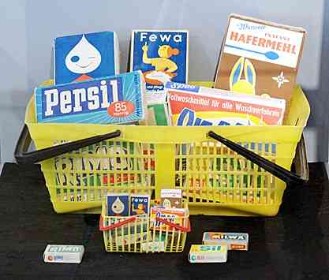
Toy grocery stores from East and West Germany offer a delightfully nostalgic journey back through recent German history. This journey begins in the lean post-war years, when substitute products like grain coffee not only shaped everyday life, but also made their way into children’s play shops in charmingly miniaturized forms. Before long, goods returned to their pre-war quality. In West Germany, Ludwig Erhard—the father of the Economic Miracle—even declared the return of Persil laundry detergent as definitive proof that peace had truly arrived.

While Western play stores burst with a wide array of beloved brand names and luxury treats, Eastern play shops focused mainly on everyday staples. Yet, in a sweet touch of premature reunification, many East German toys crafted for export were actually packed with Western products.

Beyond tracking changing package designs and shifting product varieties in miniature, these play shops offer a heartwarming glimpse into how shopping itself transformed—from cozy mom-and-pop corner stores to modern supermarkets.

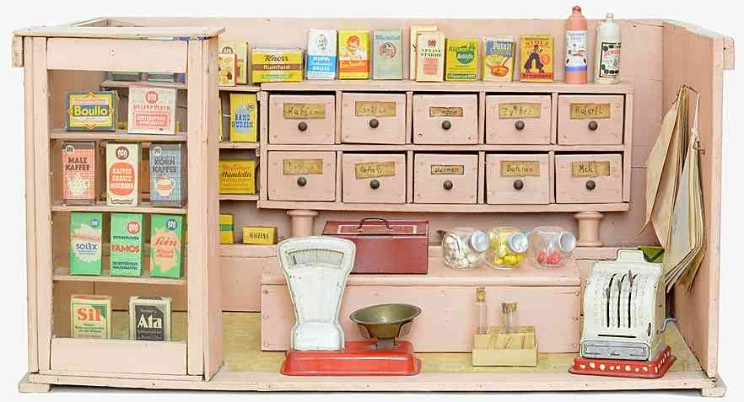
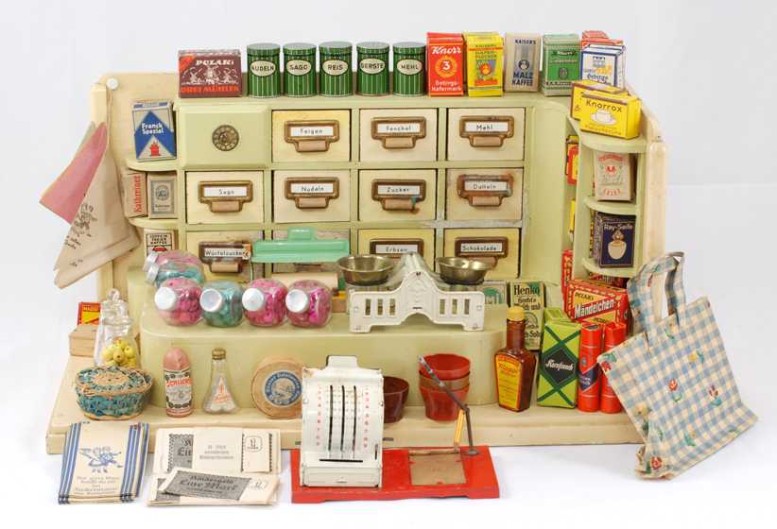
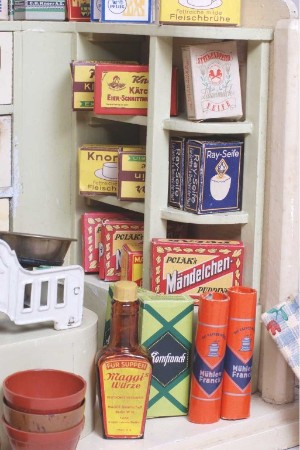
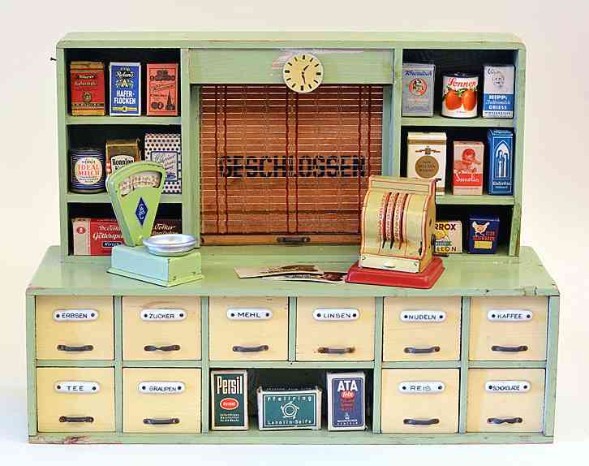
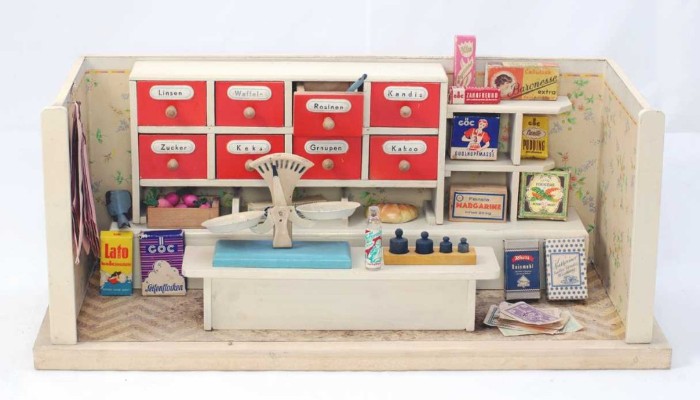
A deeply evocative, simply constructed play shop from the post-war years. Crafted from repurposed wooden crates, the back shelving unit rests on discarded thread spools, while the blank margins of old sheets of postage stamps served as drawer labels.

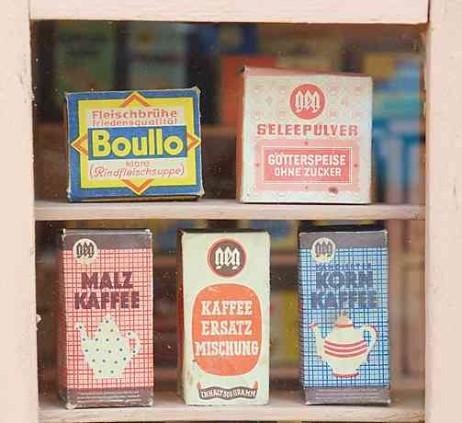
Because supply conditions across Germany were extremely dire and certain raw materials had virtually disappeared, the shop’s stock features many substitute items that defined daily German life—such as grain coffee and sugar-free gelatin (“Götterspeise”). Overall, the selection in this child’s play shop was almost certainly more varied than what could be found in a real store at the time.

Dimensions: 57 x 34.5 x 29 cm (approx. 22.4 x 13.6 x 11.4 inches)

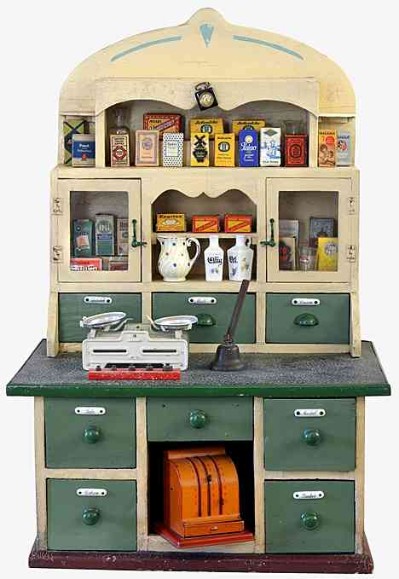
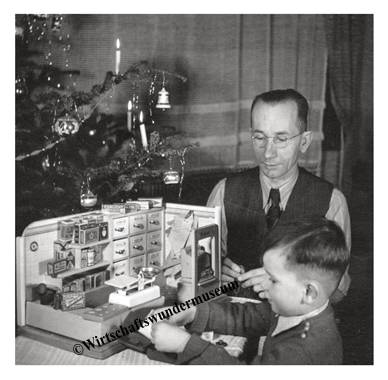
A handmade play shop built in 1937 by the father of its original owner, Anita. The surviving play food and goods have been thoughtfully supplemented with authentic period pieces.

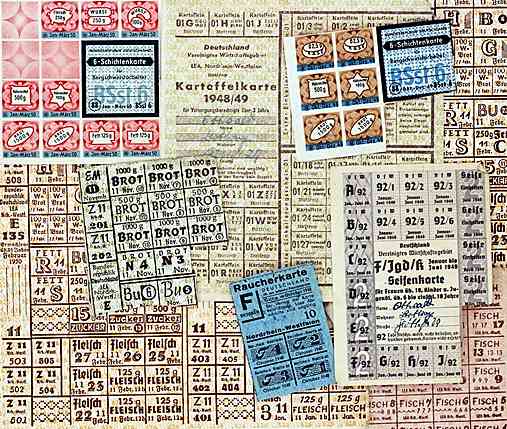
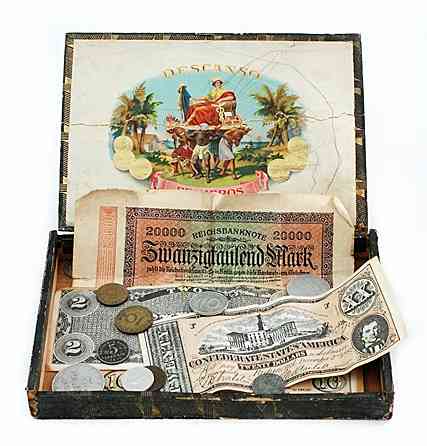
Particularly fascinating is an original cigar box filled with actual decommissioned currency that served as play money. The contents range from historic US dollar bills and coins from the 1920s through the 1940s to old ration coupons—the latter having been virtually priceless during the lean post-war years. After conditions improved following the 1948 currency reform, rationing was gradually phased out, leading these dramatic tokens of history to find a new home inside this play shop.

My heartfelt thanks go out to Anita, who penned her memories of the shop in the sweetest fairytale fashion:

“Once upon a time, many years ago, there was a little girl—let’s call her Anita. Oh, how she wished for a play shop of her own, but where could one possibly find one? More than anything, she wanted to be a shopkeeper. Christmas was drawing near, so her father said to his wife, ‘I’ll give it a try and build one myself. Lord knows I have more than enough time.’ He was out of work at the time. So every day, he would go down to the basement and set to work. There was plenty of gluing, screwing, and hammering. The little girl often stood by, watching intently, wondering what could possibly be in the works. She pondered feverishly every day, but just couldn’t figure it out. Eventually, she wasn’t allowed in the basement anymore, as it was meant to be a Christmas surprise. Bit by bit, the play shop took shape and finally received a lovely coat of paint. Christmas Day arrived at last, and the long wait was finally over! Oh, the sheer joy of that little girl! Standing beneath the decorated Christmas tree, fully equipped with all the trimmings, was a play shop! She clapped her little hands, and her happiness knew no bounds.”

Dimensions: 59 x 34 x 75 cm (approx. 23.2 x 13.4 x 29.5 inches)

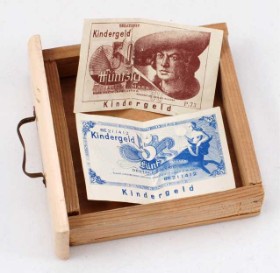
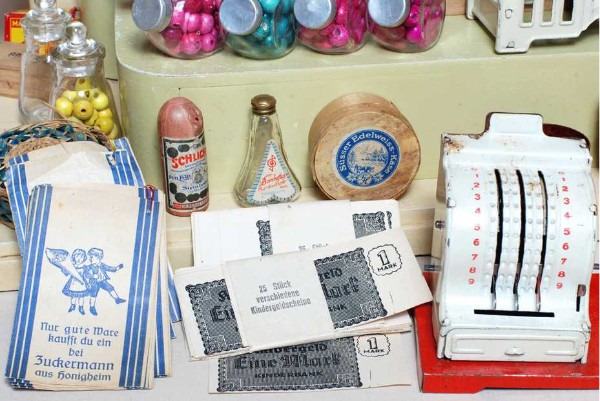
Likely a play shop from the 1920s or 1930s that survived the war and was lovingly played with into the late 1940s and early 1950s. We can pinpoint this era through the play money, modeled after the banknotes issued in West Germany starting in 1949 by the Bank Deutscher Länder, and a “Geobra” paper dispenser stamped “Made in US-Zone.”
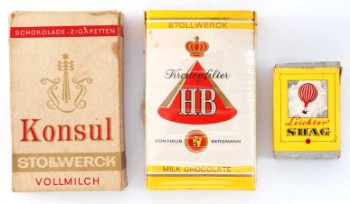
Chocolate cigarettes alongside a tiny play box of “Leichter Shag” pipe tobacco gently hint that a family of smokers once lived here! 😉
Dimensions: 43 x 14 x 40 cm (approx. 16.9 x 5.5 x 15.7 inches)
 
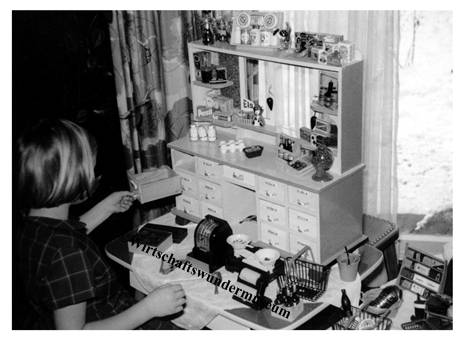
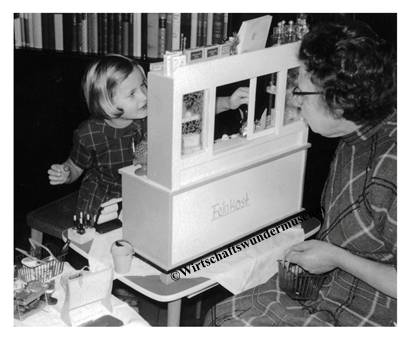
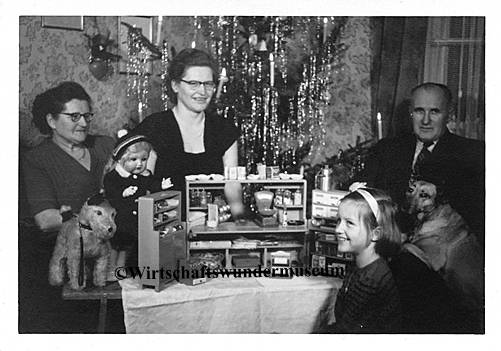
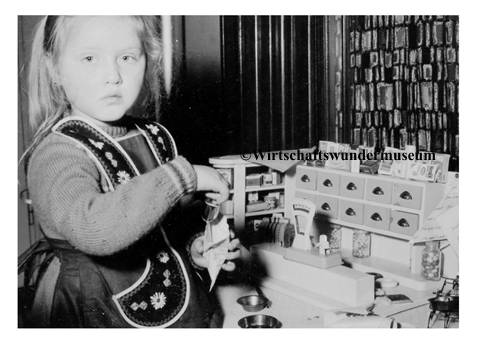
Im Kinder-Kaufladen wird die Ware sortiert.
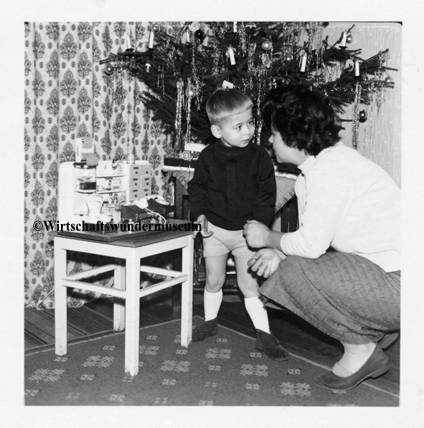
Kundschaft! (Privatfotos Sammlung Wirtschaftswundermuseum, um 1960)

Ein Kaufladen der Firma Albin Schönherr, den ich mitsamt Inhalt von der ursprünglichen Besitzerin erhielt, die damit in den frühen 1940er Jahren gespielt hat. Maße: 50 x 24 x 24 cm

"Weihnachten den 24.12.43 zum Andenken"
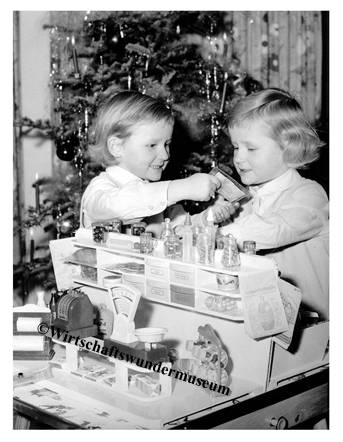
Ein Kaufladen unter dem Weihnachtsbaum (1952)

The Post-War Years

After years of hardship, the end of World War II does not mean an immediate turn for the better in Allied-occupied Germany. Shortages are everywhere, particularly when it comes to food. Although a good harvest in 1946 offers slight relief, the harsh, unforgiving winter that follows turns into a desperate “Hunger Winter.” The few foodstuffs available are strictly rationed and distributed through ration coupons. Anyone with valuable possessions tries to trade them on the black market for something to eat.
By 1948, conditions in the Western zones begin to gradually ease thanks to the American-led reconstruction efforts of the Marshall Plan and the introduction of the Deutsche Mark (DM). In the Soviet Zone, however, recovery moves much more slowly, burdened by the heavy reparations demanded by the Soviet Union.

In children’s play shops, numerous artifacts from the post-war era vividly document both the lean times and the steady progress. Among them are miniaturized packages of sugar-free gelatin (“Götterspeise”), grain coffee, and even meat soup boasting a return to “peace-time quality.” Even obsolete ration coupons, no longer needed after the end of price controls and strict rationing, found a second life as play money.

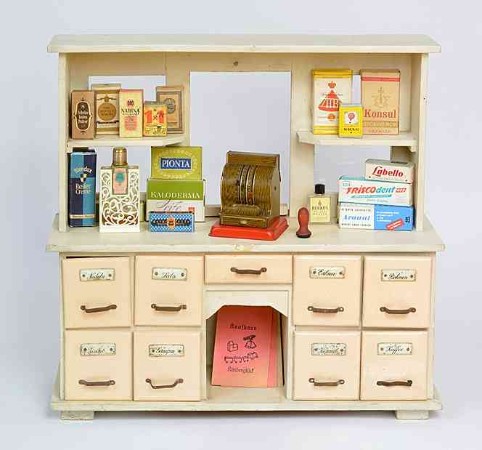
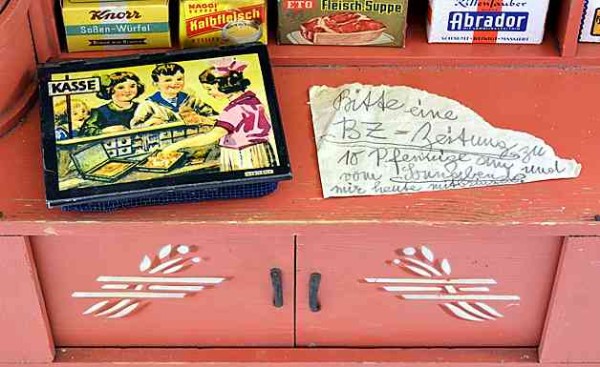
Kaufladen “Konsum”, frühe 50er Jahre, Hersteller wohl E. Emil Schubert, DDR. Vorhandene Restbestückung (BRD) zeittypisch ergänzt, in den Fächern des Mittelstücks befanden sich ursprünglich einmal Schubladen. Maße 49 x 17 x 37,5 cm, – Im Kaufladen gefunden: “Bitte eine BZ-Zeitung zu 10 Pfennige am und vom Sonnabend mir heute mitbringen.”

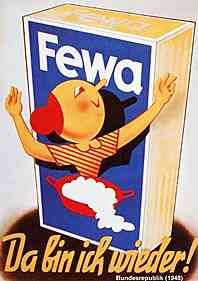
Fewa - "Da bin ich wieder!", Werbung (1948)
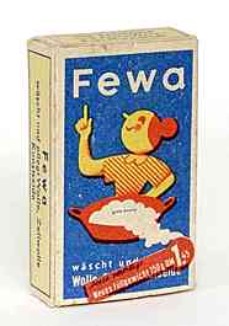
Fewa - Kaufladenschachtel
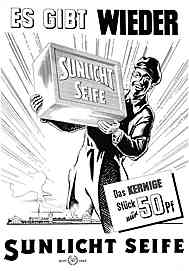
"Es gibt wieder Sunlicht Seife" (1949)
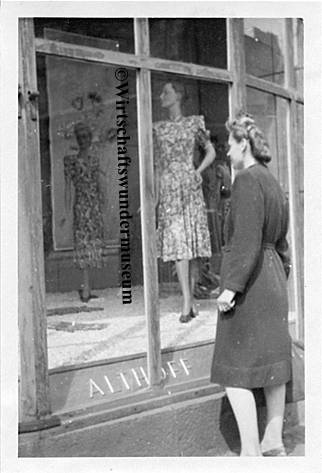
Vor einem Schaufenster des Kaufhaus Althoff (1948)
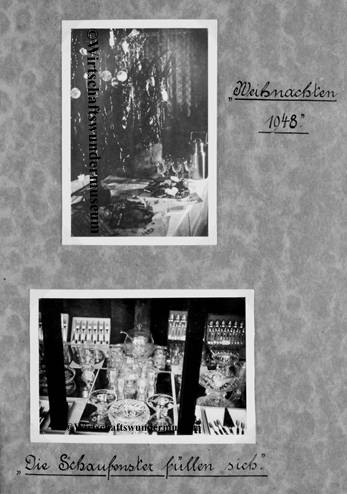
"Weihnachten 1948 - Die Schaufenster füllen sich." - Seite aus einem privaten Fotoalbum
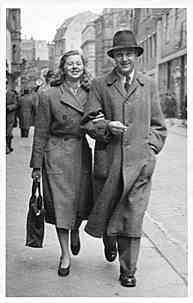
Einkaufsbummel in Iserlohn (1948)
Kaufladen um 1954, Hersteller E. Emil Schubert "Fabrik feinster Holzspielwaren", Grünhainichen/Erzgebirge, Maße: 46 x 16 x 34 cm

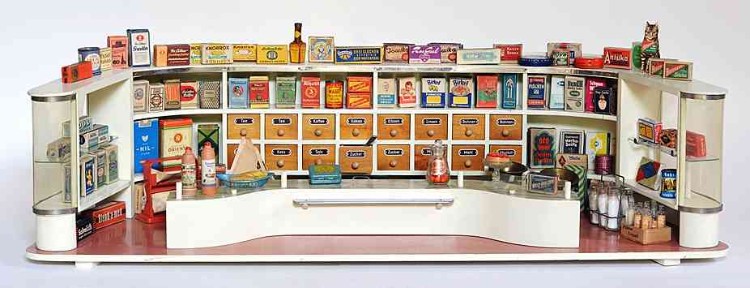
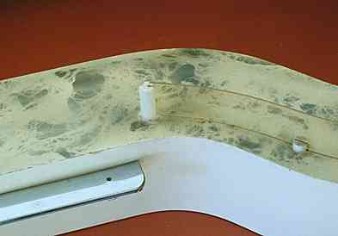
Riesiger (100 x 36 x 26 cm) Kaufladen der Firma Kibri mit formschöner Verkaufstheke (inklusive chromglänzender Taschenablage!), deren Oberfläche eine edle “Marmoroptik” aufweist. Erstaunlicherweise ist der Laden mit “Made in US-Zone” gemarkt, was die Herstellungszeit theoretisch bis 1949 begrenzt. Es fällt schwer, diese frühe Datierung zu glauben, denn soviel räumlicher Überfluss passt einfach nicht in diese Zeit. – Aber während Blechspielzeuge oft noch viele Jahre länger derart gekennzeichnet wurden, weil es sehr aufwändig gewesen wäre, die Druckstöcke für deren Lithografien zu ändern, fällt dieses Problem bei diesem Laden weg, da es in diesem Fall lediglich eines neuen billigen Gummistempels bedurft hätte. Warum hätte man also eine falsche Angabe machen sollen? Möglicherweise beschlossen die Kibri-Verantwortlichen die Produktion dieses Ladens in einer allgemeinen Währungsreform-Euphorie? Auf jeden Fall schien er die potenzielle Käuferschaft zu überfordern, da dieses Spielzeug unbespielt anmutet und ein zweites mir unter die Augen gekommenes Exemplar ebenfalls einen nahezu neuwertigen Eindruck machte. – Die hier zu sehende Bestückung wurde von mir zeittypisch zusammengestellt. 

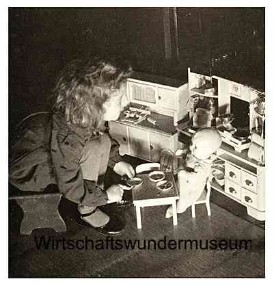
Kind spielt mit einem Kaufmannsladen (um 1955)
Spiel mit Puppe und Kaufladen (um 1950)

Kleiner Kaufladen um 1950, noch ganz im Stil der 1930er Jahre, Maße: 48 x 18,5 x 28 cm   

Planned Economy and the Economic Miracle

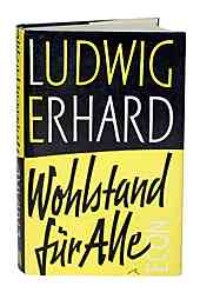
“Prosperity for All” (Wohlstand für alle) was the title of a 1957 book by West German Economics Minister Ludwig Erhard, and indeed, life steadily improved for a vast majority of West Germans throughout the 1950s. The economy rebounded from the devastation of World War II far faster than expected, wages rose, and store shelves overflowed with everything shoppers could desire—giving rise to the phrase “Economic Miracle” (Wirtschaftswunder).
In East Germany, supply conditions also improved, though shortages remained a recurring reality. Compared to the West, the selection was modest, as the socialist state prioritized heavily subsidized basic staples like bread, butter, and milk. Coveted luxury goods were often kept hidden under the counter as Bückware (“under-the-counter goods”), and when sought-after items did appear in stores, shoppers faced long lines. Popular wit summed it up: “Everything exists—just not always, not everywhere, and certainly not when you actually need it.” While West German shopkeepers cheerfully asked, “May I give you a little extra?”, East German customers were far more likely to hear a blunt, “We don’t have it!”
Children’s play shops from this era vividly capture these contrasting worlds. Western play stores burst with colorful miniature boxes of well-known brands and luxury treats, while Eastern sets focused primarily on daily essentials. Because production was controlled by a planned economy without competition, packaging design for the domestic market was often overlooked. Visitors to the trade fair in Leipzig were frequently astonished to see the surprisingly attractive products East German factories were capable of producing—specifically reserved for lucrative export markets.
Ludwig Erhard: Wohlstand für Alle
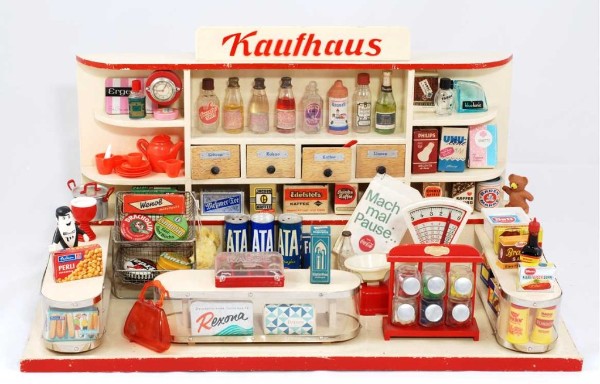
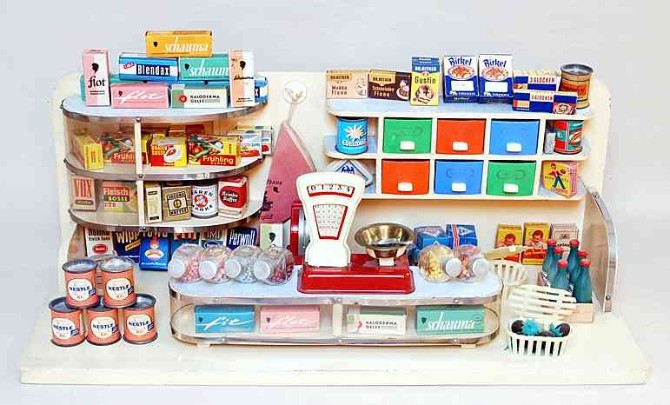
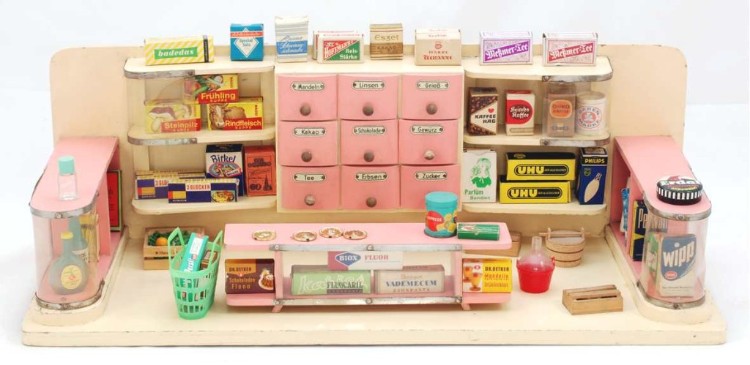
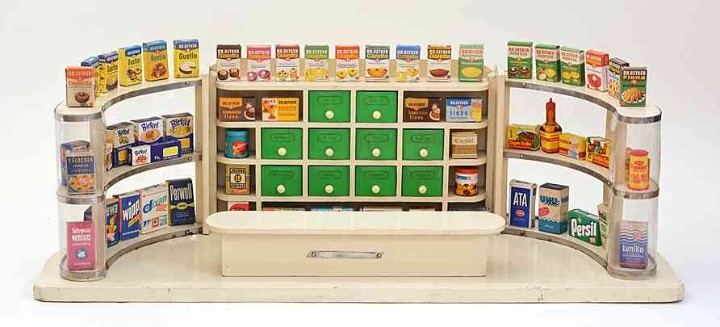
Dieses reich gefüllte "Kaufhaus" spiegelt anschaulich den Wohlstand der Wirtschaftswunderzeit wider. Maße: 58 x 30 x 31 cm
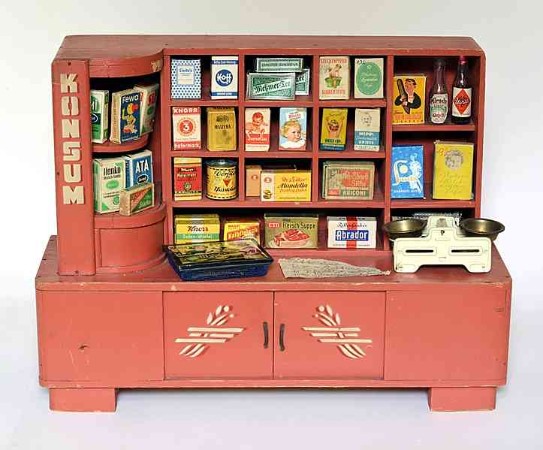
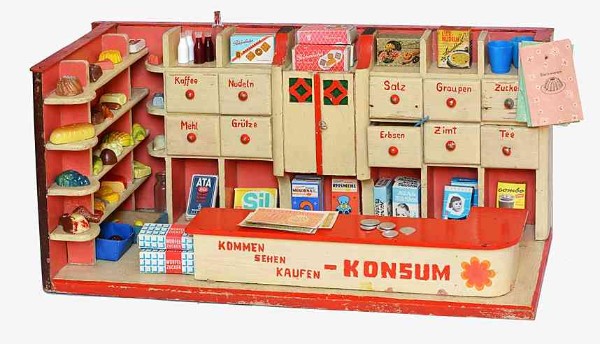
“COME SEE BUY – KONSUM” (“KOMMEN SEHEN KAUFEN – KONSUM”) , East Germany, a handcrafted play shop filled with original goods. Unlike the state-run HO (Handelsorganisation), the “Konsum” shops were owned by the members of the consumer cooperatives united under the brand. In daily East German life, “Konsum” gradually became the everyday word for local grocery stores.
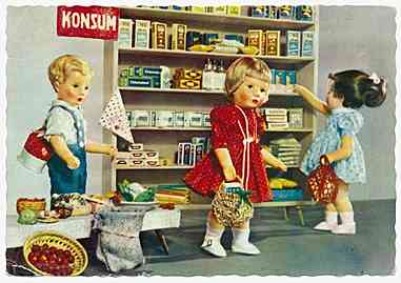
Dimensions: 51 x 22 x 24 cm (approx. 20.1 x 8.7 x 9.4 inches) – Picture postcard / photo card “Konsum”
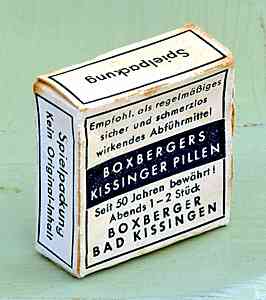
Play shop, East Germany, equipped with West German goods. Dimensions: 76 x 33 x 25 cm (approx. 29.9 x 13.0 x 9.8 inches) Featured below is a true curiosity from this shop's stock—a striking symbol of Economic Miracle prosperity, the era's infamous "gluttony wave" (*Fresswelle*), and the resulting weight struggles of many West Germans: a toy package of laxatives!
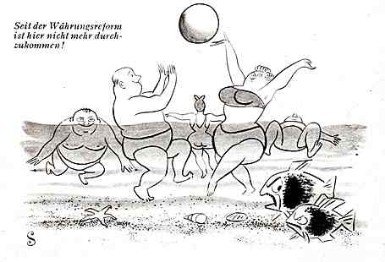
"Since the currency reform, there's just no getting through here," cartoon from a magazine (1950)
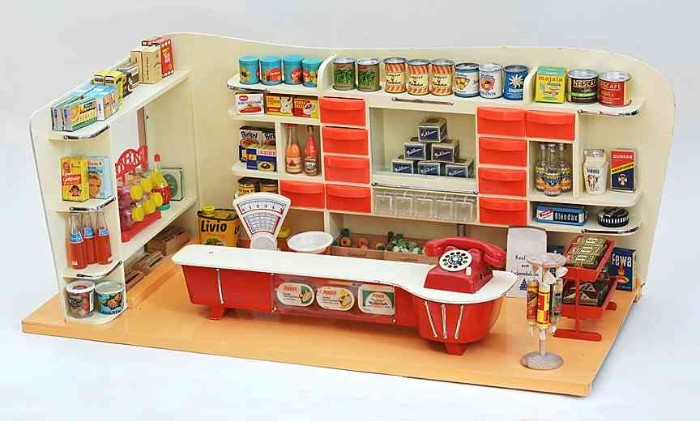
Kaufladen um 1958, original bestückt, Maße: 60 x 26 x 24 cm

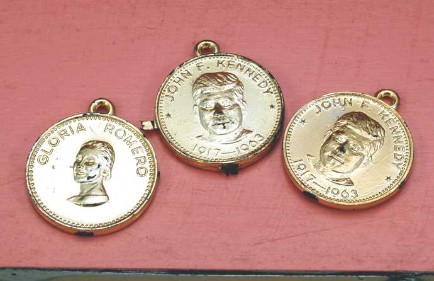
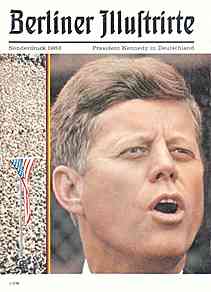
This originally equipped play shop from the early 1960s tells a story of modern history: the John F. Kennedy plastic coins shown here were used by children as play money. U.S. President Kennedy’s visit to Berlin—celebrated for his legendary words, “Ich bin ein Berliner!”—had captivated the West German public and became a ubiquitous topic, leading to souvenir knick-knacks finding their way even into children’s toys like this one.

Dimensions: 61 x 24 x 21 cm (approx. 24.0 x 9.4 x 8.3 inches)

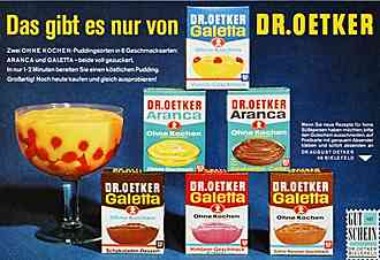
Ein Kaufladen aus den 1960er Jahren mit allein 24 verschiedenen Miniaturschachteln von Produkten der Firma Dr. Oetker, der die große Vielfalt des bundesdeutschen Warenangebotes widerspiegelt. Maße: 72 x 28 x 22 cm
"Das gibt es nur von DR. OETKER", Printwerbung (1966)
Kaufladen mit Schaufenster der Firma HEDO (Herbert Dohnalek), um 1960, Maße: 79 x 34 x 34 cm  
Self-Service and the Supermarket
With the economic boom of the mid-1950s, the variety of available goods expanded rapidly. While stores had previously stocked mostly regional items, advancements in transportation and new refrigeration systems allowed nationwide products and imported goods to fill shop shelves. In 1955, a survey by the Allensbach Institute for Public Opinion Research revealed that the refrigerator topped the list of consumer goods West Germans considered necessary for a “decent standard of living”—ahead of both washing machines and vacuum cleaners. Initially a luxury item for the wealthy, mass production soon made it affordable for everyday wage earners.
While homemakers had previously gone shopping almost daily, this new major appliance revolutionized household planning. Leftovers no longer had to be eaten the next day to prevent spoilage, and stocking up on fresh, perishable foods became possible. Retailers responded by not only introducing a wider variety of products, but also keeping larger quantities in stock.

However, this massive expansion of inventory made traditional counter-service shops too labor-intensive and financially unviable. Budgets previously set aside for staff wages were now funneled into modern infrastructure: larger retail floors, expanded storage space, modern cash registers, and refrigeration equipment. The shift toward the self-service era had begun.

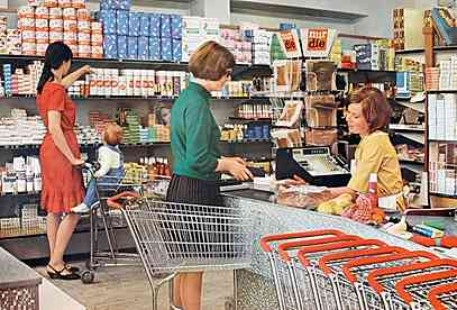
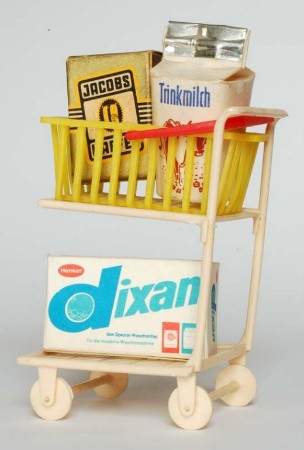
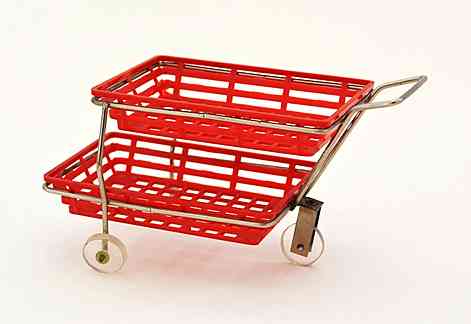
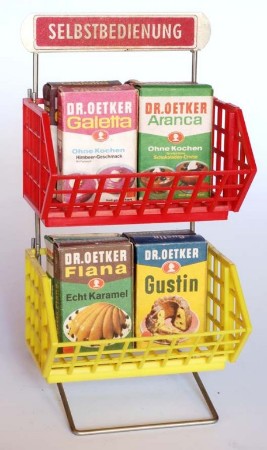
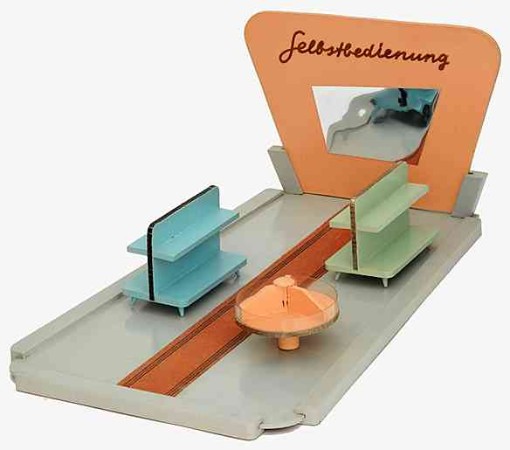
Following an initial trial in Osnabrück in 1939, a permanent self-service experiment was launched in Hamburg in 1949. Growth was initially slow, largely due to older shoppers who were hesitant to embrace the unfamiliar format. Many missed the familiar chatter with their local grocer, who was usually the go-to source for neighborhood news and gossip. The tradition of buying on credit (“putting it on the tab”) during tight financial times was also gone. In 1952, there were only 131 self-service stores in West Germany; by 1960, that number had surged to roughly 23,000, eventually peaking in the early 1970s at nearly 150,000—a figure that included supermarkets, department stores, and discount chains. As shown here and on the following pages, children’s play shops offer a fascinating look into this evolution from cozy corner mom-and-pop stores to modern supermarkets!

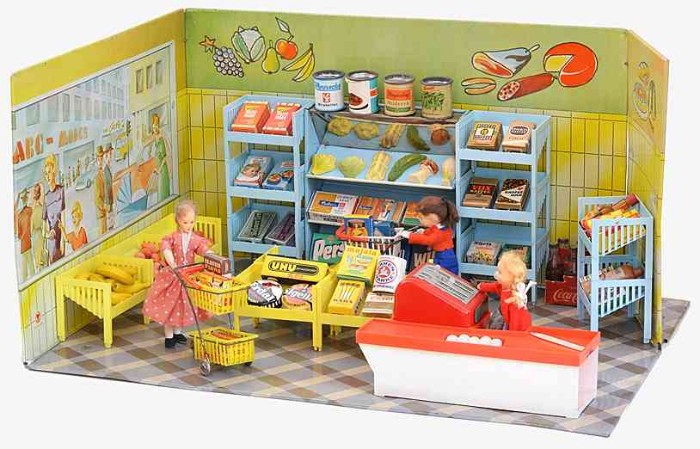
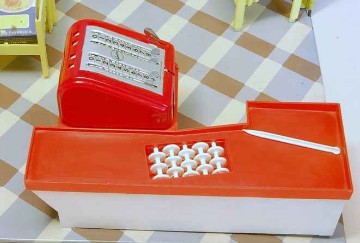
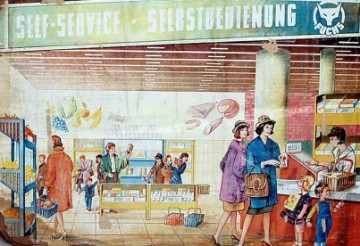
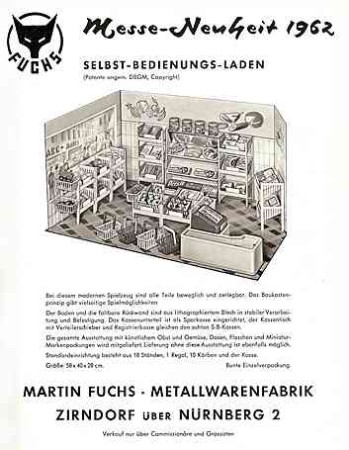
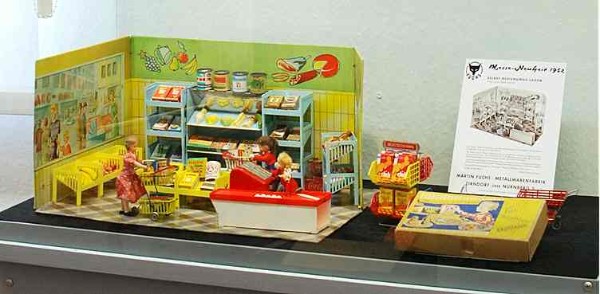
“Self-Service Store” – “With this modern toy, all parts are movable and can be disassembled. The modular construction offers versatile play possibilities. The floor and foldable back wall are made of sturdy lithographed tinplate with robust fixings. The base of the cash register doubles as a money box, while the checkout counter with a sliding divider and cash register mirrors authentic self-service checkouts.” – Martin Fuchs Metalware Factory, Zirndorf near Nuremberg (1962) – Dimensions: 58 x 40 x 28 cm (approx. 22.8 x 15.7 x 11.0 inches)

Austellungs-Impression
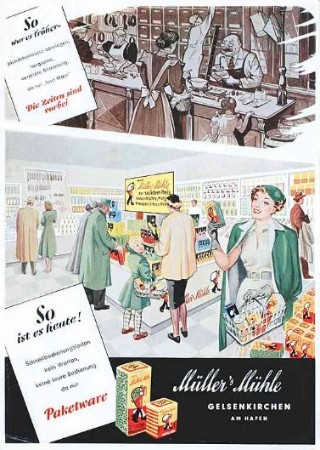
"So war es früher - pfündchenweise abwiegen, langsame, veraltete Bedienung, da nur "lose Ware". Die Zeiten sind vorbei" - "So ist es heute! Schnellbedienungsladen, kein Warten, keine teure Bedienung, da nur Paketware" - Werbung, Müller's Mühle, 1954
"Beim Kaufmann", Rollbild / Rolltafel / Lehrbild für Schulen, Maße: 92 x 64 cm
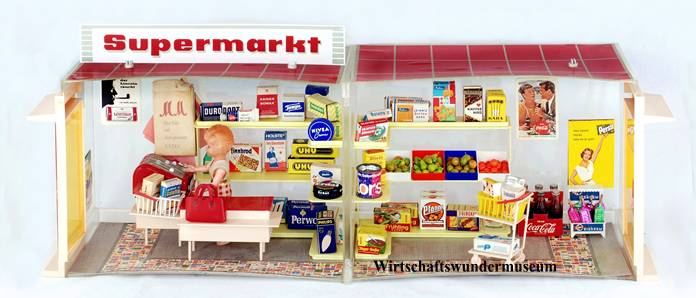
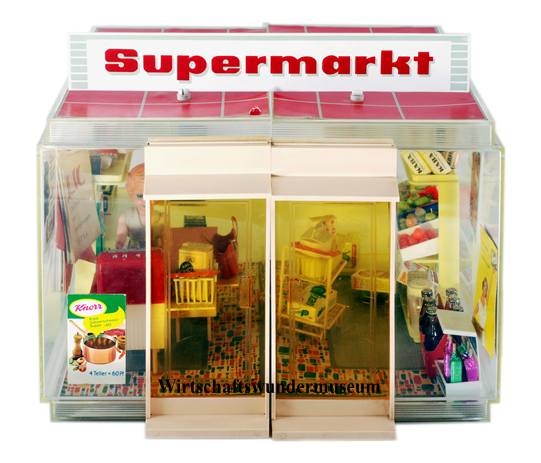
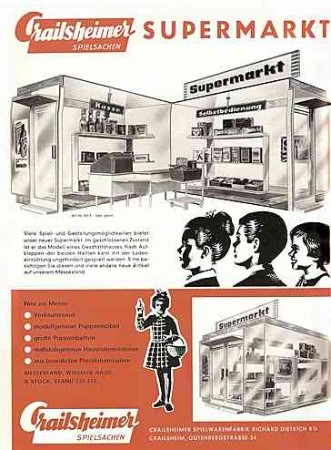
Der Supermarkt der Crailsheimer Spielwarenfabrik aus dem Jahr 1963 mit getrenntem Einkaufs- und Kassenbereich dokumentiert den Wandel vom traditionellen "Tante-Emma-Laden" hin zum Selbstbedienungsgeschäft. Material ist transparenter Kunststoff, der in seiner Beschaffenheit an die Gemüseschubladen alter Kühlschränke erinnert. Maße: geschlossen: 40 x 42 x 28 cm, geöffnet: 84 x 20 x 28 cm (jeweils ohne "Supermarkt"-Schild) 
"Viele Spiel- und Gestaltungsmöglichkeiten bietet unser neuer Supermarkt. In geschlossenem Zustand ist er das Modell eines Geschäftshauses. Nach Aufklappen der beiden Hälften kann mit der Ladeneinrichtung ungehindert gespielt werden." Crailsheimer Spielwarenfabrik Richard Dietrich KG (1963)
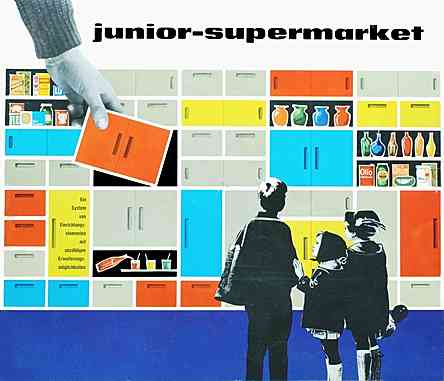
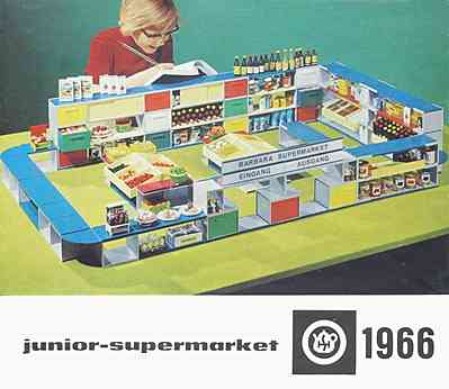
"junior-supermarket" von Hans Seidel, Zirndorf, aus dem Jahr 1966. – "Ein System von Einrichtungselementen mit unzähligen Erweiterungsmöglichkeiten."
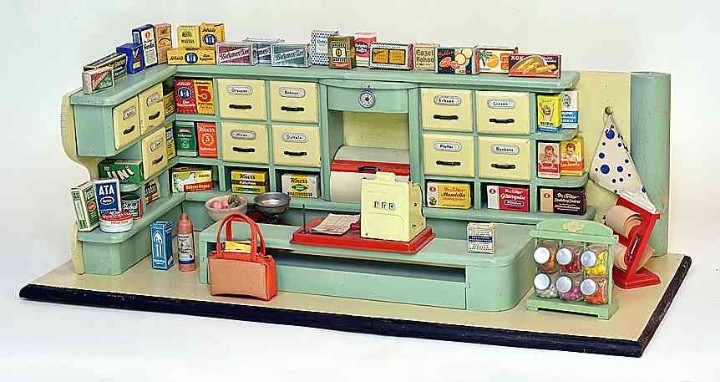
Dieser formschöne Kaufmannsladen ist aufgrund sehr begrenzter Stellmöglichkeiten für "Waren" eher ein (ausgesprochen reizvolles) Design-Objekt denn brauchbares Spielzeug. Hersteller: VEB Seiffener Spielwaren/DDR,  Maße: 51 x 31,5 x 22 cm.
Brand Name Products
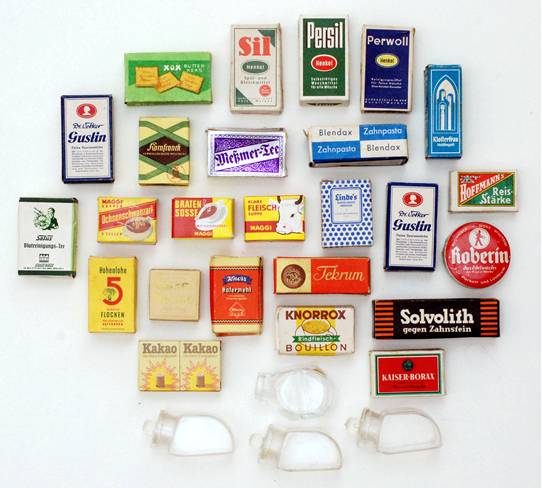
Children’s play shops offer a vivid look into the development of food manufacturers in post-war West Germany, documenting the unstoppable rise of brand-name products.
Previously, typical shop inventory consisted of a modest selection of goods from well-known manufacturers, alongside bulk, unbranded items stored in barrels, sacks, jars, and labeled drawers that were weighed and packaged to order. With the introduction of self-service, however, the number of pre-packaged, standardized branded products skyrocketed. As the shopkeeper’s role shifted from active salesmanship to store management, packaging had to do more than just protect its contents: it needed eye-catching, distinctive designs to capture shoppers’ attention, along with printed product details to inform them on the spot.

As expanding store shelves offered customers multiple choices for any given item, advertising rapidly gained importance. Marketing strategists realized early on the powerful promotional impact and early brand loyalty created by placing their products inside children’s play shops.

Companies eagerly collaborated with miniature box manufacturers, supplying print templates and often covering a portion of the production costs. Notably, products with prominent brand names dominated children’s playrooms, as parents naturally gravitated toward market leaders—not only in supermarkets, but in toy stores as well. Smaller regional brands rarely made it into these miniature play sets.

As a result, these miniature packages provide a rich timeline of evolving product design. Companies particularly invested in this early form of product placement faithfully mirrored even the smallest changes to their real-world packaging in their miniature play shop versions.

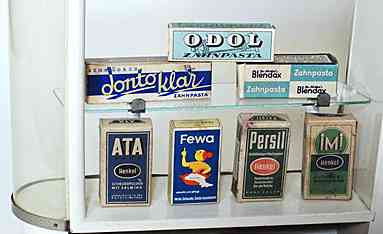
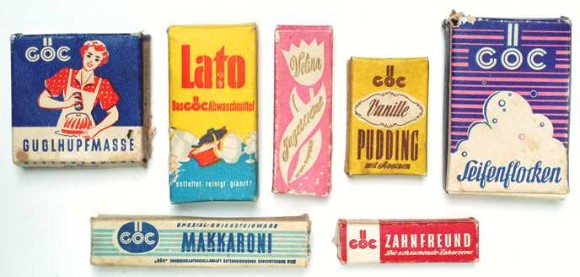
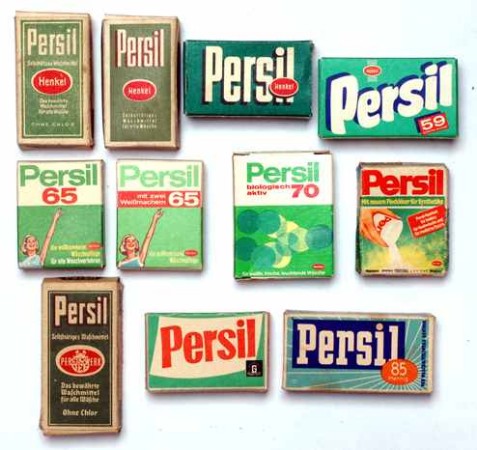
„Persil“-Schächtelchen, die Entwicklungen des Produktdesigns von der Nachkriegszeit bis in die 70er Jahre dokumentieren. – Auch in der DDR gab es längere Zeit ein Waschmittel mit dem Namen „Persil“ zu kaufen. Produziert wurde es im 1921 gebauten Henkel-Werk in Genthin, das nach seiner Enteignung im Jahr 1949 „VEB Persil-Werk“ hieß. Nach der Einführung eigener Entwicklungen wie Milwa und später Spee wurde die Marke „Persil“ Ende der 1960er Jahre in der DDR jedoch vom Markt genommen.

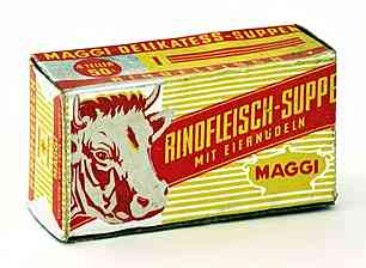
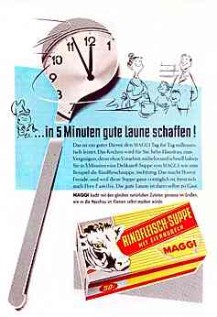
Kaufladenschachteln als Spiegel deutscher Esskultur: Mitte der 1950er Jahre brummt die Wirtschaft, viele Frauen gehen arbeiten und mangels Zeit muss die Zubereitung von Mahlzeiten schnell gehen! – Maggi Rindfleisch-Suppe – “…in 5 Minuten gute Laune schaffen!”, Werbung (1954)

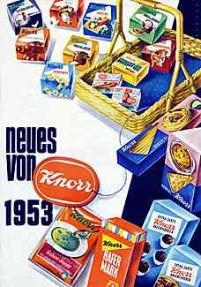
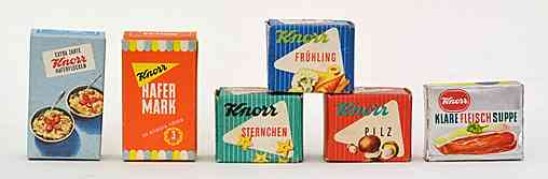
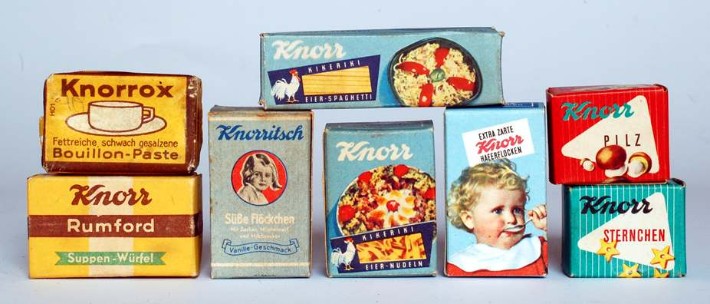
Kaufläden ermöglichen eine Zeitreise: Das Verpackungsdesign der Firma Knorr aus dem Jahr 1953 findet sich originalgetreu im Kinder-Kaufladen wieder.

Knorr-Produkte für den Kinder-Kaufladen, 1945 - 1965, Schachtellänge 30-65 mm
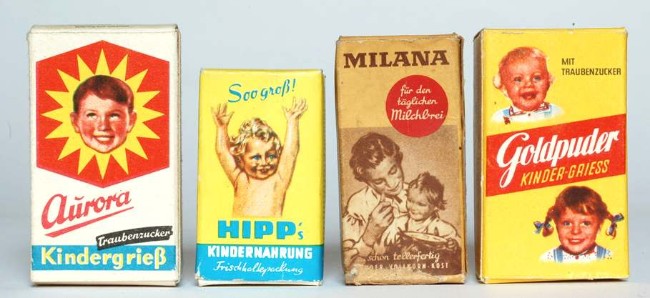
Kindernahrungsprodukte der 50er Jahre, Höhe 45-53 mm

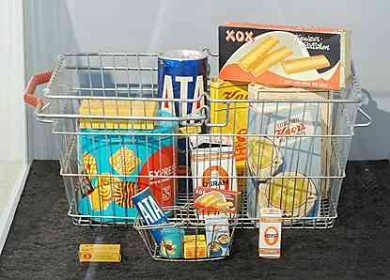
Miniaturen für den Kinder-Kaufladen spiegeln das Produktdesign ihrer Zeit. “Echte” Waren aus der Bundesrepublik und der DDR (rechts) im direkten Vergleich mit ihren spielgerecht verkleinerten Entsprechungen im Rahmen meiner Kaufladen-Ausstellung “Kaufrausch im Kinderzimmer. Kinderkaufläden – ein Spiegel deutscher Konsumgeschichte” im Museum Petersberg.

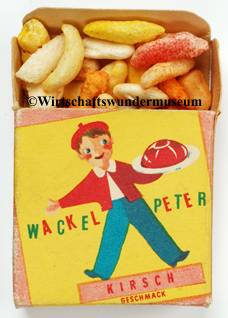
My heartfelt thanks go out to Hannelore for these play shop boxes. She fondly recalls: “When I first received the boxes, they were often filled with tiny, brightly colored puffed rice grains—if you kept them too long, they eventually tasted stale. At one point, I filled the jars with grass seeds, until it turned out there were insects inside as well…”

By the way, in my experience, whether these boxes were eaten empty or, conversely, still retain their original puffed rice, usually reveals quite a bit about the availability of sweets in a given household. Only if treats were plentiful could a child afford the luxury of turning their nose up at those tiny colored grains—a theory confirmed to me by many original owners, as well as by Hannelore: “Indeed, we didn’t have sweets at home very often. Chocolate was pretty much reserved for when visitors brought something along, or for birthdays and Christmas, which is why the Christmas treat plate (“süßer Teller”) was such a huge highlight.”

Kaufladenartikelsortiment, Koch & Hofmockel, Nürnberg, um 1948
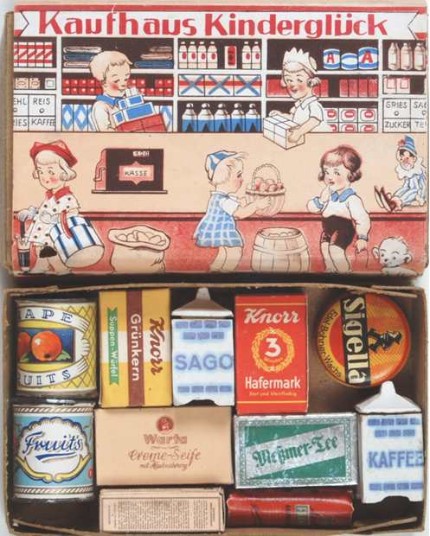
"Kaufhaus Kinderglück", Schachteln für den Kinder-Kaufladen, frühe 50er Jahre

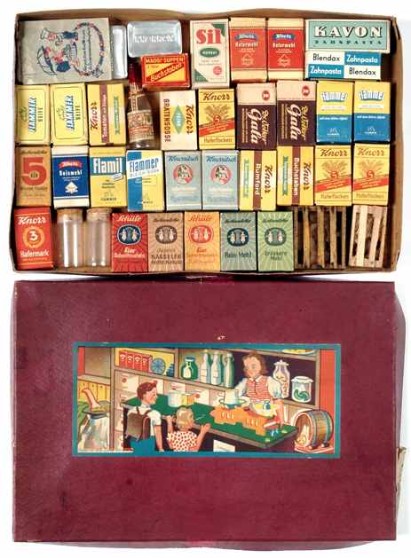
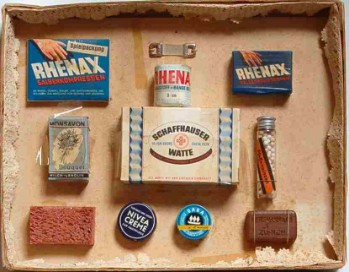
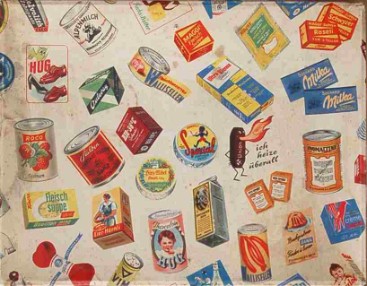
Drogerieartikel für den Kinder-Kaufladen und Deckel des Verkaufskartons, frühe 50er Jahre.

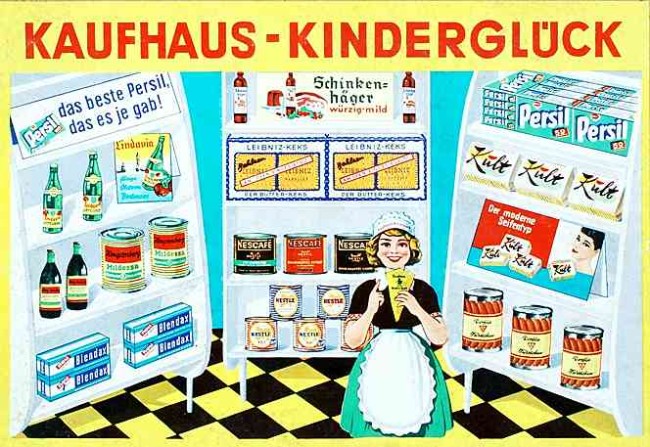
Geschenkkarton für Kaufladenschachteln: "Kaufhaus Kinderglück", J.J. Landmann, Nürnberg, um 1960
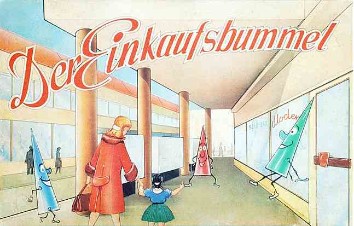
"Der Einkaufsbummel", Würfelspiel
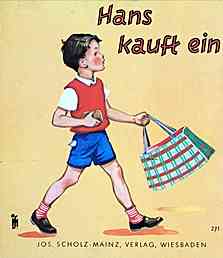
"Hans kauft ein", Kinderbuch
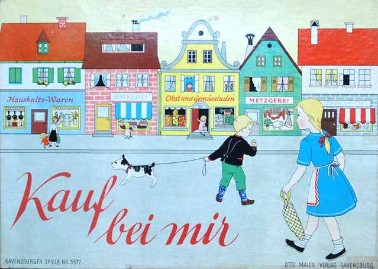
"Kauf bei mir", Gesellschaftsspiel

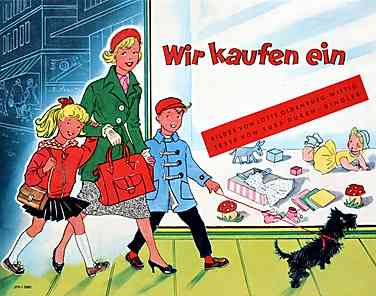
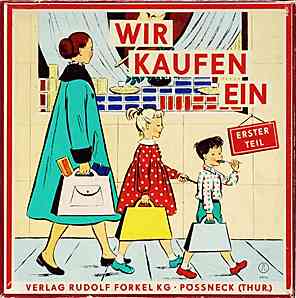
Reizvoller Ost-West-Vergleich: “Wir kaufen ein” aus der Bundesrepublik (wohl 1960), ein “Spiel-Bilderbuch mit Figuren zum Einstecken” und “Wir kaufen ein” aus der DDR (1959), ein “Such- und Legespiel” vom Verlag Rudolf Forkel KG Pössneck.

In eigener Sache ein Hinweis auf die Wanderausstellung:

Darf’s ein bisschen mehr sein?

Vom Tante-Emma-Laden zum Supermarkt

Spielzeug-Kaufläden der Nachkriegszeit aus der Bundesrepublik und der DDR als Spiegel von Konsumverhalten und Produktdesign

Bisherige Stationen:

13.3. – 30.8.2009 Grafschafter Museum Moers
11.7. –   6.9.2015  Museum Petersberg/Saalekreis

Unter dem Alternativ-Titel “Konsum im Kinderzimmer” 11.10.2015 – 28.2.2016 Kreismuseum Prinzeßhof Itzehoe

Informationen zur Ausstellung:

Spielzeug-Kauläden aus der DDR und der Bundesrepublik ermöglichen eine ebenso interessante wie unterhaltsame Zeitreise in die jüngere deutsche Vergangenheit. Sie beginnt in den Mangeljahren der Nachkriegszeit, in der Ersatzprodukte wie Getreide-Kaffee nicht nur den realen Konsum-Alltag prägen, sondern in spielgerecht verkleinerter Form auch in den damaligen Kinderkaufläden zu finden sind. Bald schon erreichen viele Waren aber wieder „Friedensqualität“ und in Bundesrepublik ist für Ludwig Erhard, den Vater des Wirtschaftswunders, der Umstand, dass „Persil wieder da“ ist, gar ein Beleg, dass nun endgültig Frieden eingekehrt ist. Während es in den Kinder-Kaufläden aus Deutschland-West ein breites Spektrum bekannter Markenprodukte und Luxusartikel zu entdecken gibt, sind in den Kaufmannsläden aus Deutschland-Ost überwiegend Waren zu finden, die der Grundversorgung der Menschen dienen. Da viele in der DDR hergestellte Spielläden für den Export bestimmt waren, findet man aber auch in einer Art vorweggenommener Wiedervereinigung Ost-Läden, die mit West-Erzeugnissen gefüllt wurden.

Doch nicht nur die Vielfalt der seinerzeitigen Warenwelt oder Modernisierungen des Verpackungsdesigns lassen sich im Miniaturformat anschaulich nachvollziehen, sondern auch die Entwicklung vom Tante-Emma-Laden hin zum Supermarkt.