About me
Collecting Philosophy of the Virtual Dollhouse Museum (also for non-collectors):
It is important to me to view old toys first and foremost in the context of the people and times in which they were made. For me, this means that I do not view historical toys—as is unfortunately often the case today—primarily as commercial items with a more or less high material value, but rather as what they were originally produced to be: small pieces of the mosaic that is childhood and, thus, the development of a very specific individual.
It is therefore undoubtedly most rewarding when I receive items directly from their original owners, who can tell me something about the history of their toys. These are often not spectacular stories or anecdotes at all, but rather a firsthand sense of the respective era—be it the 1930s, 1950s, or 1970s. In any case, however, a firsthand account of children’s lives, their outlook on life, and the little things of everyday life is far more important to me than researching manufacturers or market values.
For example, if I’m lucky enough to receive a dollhouse from its original owner, I always leave the toys in their original condition. Normally, I set up the dollhouse exactly as the child who owned it originally furnished and played with it. If pieces of furniture or little dolls were added as gifts over several years and don’t match the taste of a “style purist,” that doesn’t matter to me. In these cases, I simply want to document them as museum pieces.
By the way: Signs of play, even significant ones, are part of the experience for me. And I even believe that toys that have never been played with have failed in their purpose!
Of course, my pages also feature dollhouses, doll rooms, and toy stores—complete with furnishings—that I’ve put together according to my own taste. However, these are clearly labeled as such! Since, as a “child of the ’60s,” I didn’t consciously experience the 1950s and my knowledge of that era has been shaped by movies, photos, and books, there’s naturally a risk of idealizing the rooms and interiors… But in this case, that’s okay. The main thing is that I had fun setting them up 🙂
But all of this is just my very personal perspective—I certainly don’t want to lecture or even “preach.” Ultimately, every collector must (and may!) decide for themselves how to handle such matters. After all, collecting should be one thing above all else: a source of joy! So: “Anything goes!”
Warm regards from Rheinberg on the Lower Rhine! I hope you enjoy discovering the treasures of the virtual dollhouse museum and have sweet dreams of the toys from your own childhood:
How it all began
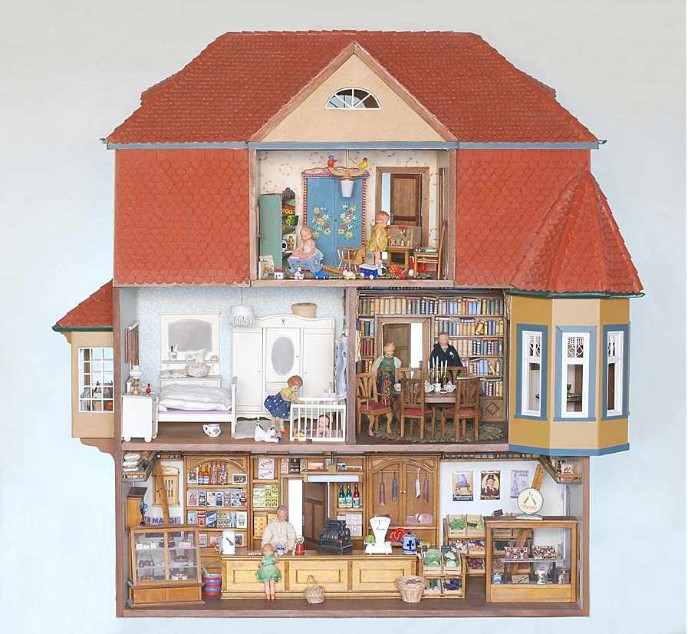
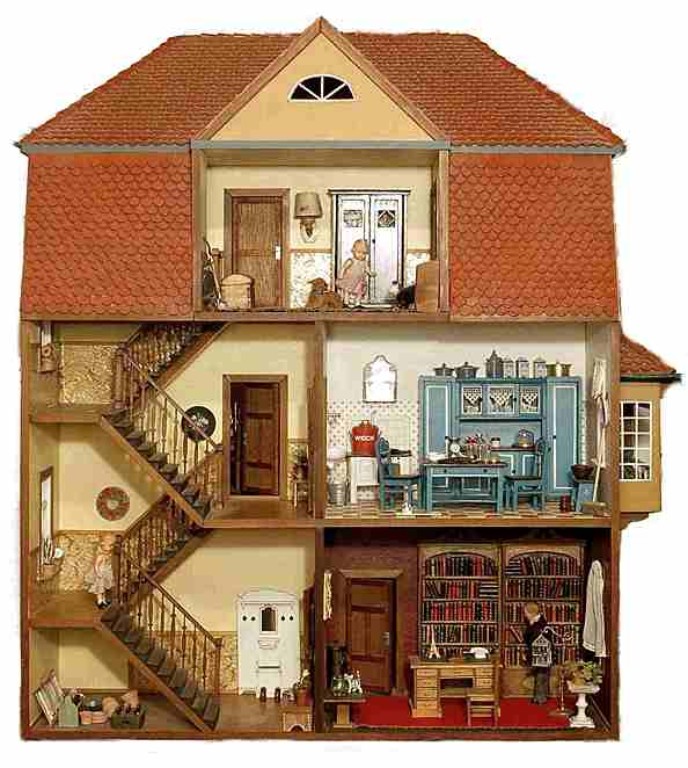
During a stay in Sonneberg, Thuringia, my then-wife and I visited the local toy museum and fell in love with a large, historic dollhouse that could be played with from all sides. – We took pictures of it and spent long winter evenings recreating the house. Cabinets, chairs, tables, and bedding: Almost everything is handmade, and over the years we’ve collected quite a few accessories to go with it.
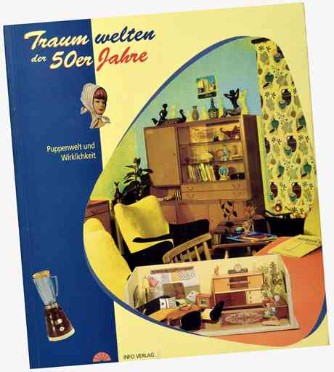
At flea markets, we discovered “really old” items and bought just about everything we liked (as long as we could afford it). Our real passion—especially for the 1950s—began when we happened to come across the catalog *Traumwelten der 50er Jahre* (*Dream Worlds of the 1950s*) for the legendary exhibition by collectors Gisela Bickel, Ingeborg Michno, and Swantje Köhler in Bruchsal.
Initial spark
We placed classified ads in newspapers with great success and received many of our treasures directly from their original owners. This is also why so many of the dollhouses, doll rooms, and toy stores featured on these museum pages are in their original condition—just as the children played with them back then. – At the beginning of the millennium, the Internet also helped us expand the collection in a targeted manner.
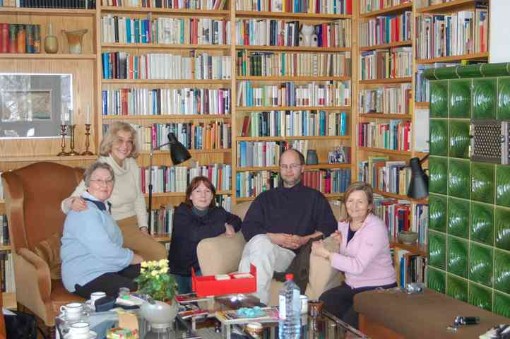
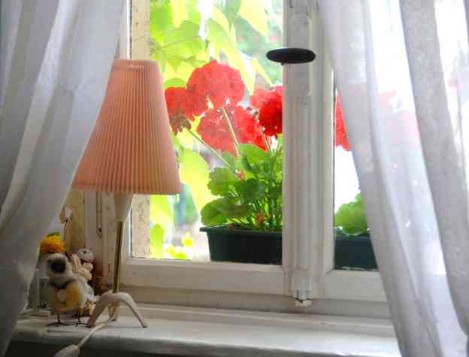
We were delighted to have been invited on several occasions by the collectors mentioned above from the Bruchsal exhibition. Pictured from left to right are: Gisela Bickel, Inge Michno (both of whom, sadly, passed away far too soon), my wife at the time, myself, and Swantje Köhler in front of Ms. Bickel’s beloved bookshelf. Thank you for the inspiration, warmth, and boundless hospitality! – Inge Michno lived in a small cottage, crammed to the rafters with dollhouses and books… The view from one of her windows perfectly captures the gentle, cozy atmosphere that reigned there.
Ms. Köhler now runs her own publishing house specializing in children’s literature, and Inge Michno’s collection can be viewed at the Dollhouse Museum in Jabobsweiler.
My dollhouse museum has now become a “one-man project,” with many other thematic areas added. Until someone proves me wrong, I’ll simply go ahead and claim that it is now the most diverse German collection of postwar girls’ toys in existence.
Nevertheless, my original dream of opening my own “real” museum that visitors can tour has been put on hold for now. The costs are too high, there are too many requirements from the authorities, and, unfortunately, too few people who are still interested in this topic. That’s why I’m trying, in this way, to make my collection of historical artifacts accessible to as many people as possible; from time to time, I also organize guest exhibitions at public museums.
Since I’m unfortunately not a wealthy person—and my financial resources as a freelance “cultural worker” are severely limited—rising costs (not least those associated with this website) are making it increasingly difficult to keep the collection together, maintain it, and preserve it for posterity, as well as to continue operating these pages at the usual high standard. Supporters, sponsors (including companies), or patrons are warmly welcome 🙂
If each of the many interested visitors considered a visit to the virtual dollhouse museum (and my other labor of love, the Economic Miracle Museum) worth even a single euro in “admission fees,” the operator would have no worries at all.
But sometimes you don’t realize something is missing until it’s gone. By then, however, it’s too late!
Email contact: kontakt@wirtschaftswundermuseum.de (which is also the address for PayPal donations, by the way 😉